
How to Check for a Hillsdale County Warrant
Hillsdale County does not run a public warrant search page. No county court office or sheriff web page publishes a live active-warrant lookup. So the honest answer to "how do I check" is a chain of fallbacks rather than one search box. Each channel below reaches a different office, and the right one depends on why you think a warrant exists.
Most people check for one of two reasons. Either they missed a court date and worry about a bench warrant, or they think an arrest warrant may be open in their name. The district court handles the first case. The sheriff handles the second. A third path, a statewide notification service, tells you when a person is booked into custody. Start with the channel that matches your situation and move down the list if it does not answer your question.
| Channel | Best For | How to Reach It |
|---|---|---|
| Sheriff FOIA portal | Written requests for warrant information held by the sheriff | Online request form |
| Sheriff phone line | Direct follow-up on a possible arrest warrant | (517) 437-7317 or (800) 437-7317 |
| 2B District Court | Bench warrants from a missed hearing or unpaid ticket | Case search plus a records request to the court |
| VINELink / MI-VINE | Custody-status alerts once a person is booked | Free registration |
| Sheriff app | Anonymous crime, warrant, and drug tips | Mobile app only |
Note: No channel here promises a complete list of every open warrant, so treat each result as one piece of a larger record rather than the final word.
Active Warrants in Hillsdale County
A warrant becomes active the moment a judge or magistrate signs it. From that point police may act on it. An active warrant does not expire on its own, and it can sit open for years until the person is arrested or clears it through the court. That is why an old missed court date can still lead to an arrest long after the fact.
Two offices generate most local warrants. The 1st Judicial Circuit Court signs felony arrest warrants and search warrants tied to serious cases. The 2B District Court signs bench warrants for people who skip a hearing or ignore a ticket. Once signed, the warrant is entered into law-enforcement systems that officers can see during a stop, even outside the county line.
Because Hillsdale County keeps no public roster, an active warrant will not show up in a simple name search the way a court case might. The state case-search portal can hint that something is wrong, since it flags open pending matters and missed events. Still, the surest confirmation comes from the office that signed the order.
Types of Warrants in Hillsdale County
Not every warrant means the same thing. The label tells you which office issued it and what triggers an arrest. In this county the two you are most likely to meet are the arrest warrant and the bench warrant, but search warrants and capias writs also appear in criminal files.
- Arrest warrant - a judge signs it when police or a prosecutor show probable cause that a person committed a crime.
- Bench warrant - the district court issues it when someone fails to appear for a hearing or ignores a court order.
- Search warrant - it lets officers search a named place or item for evidence and is not aimed at arresting a person.
- Capias - a failure-to-appear or body-attachment writ that works much like a bench warrant to bring a person before the court.
Bench warrants matter most for everyday cases. A forgotten traffic ticket or a missed misdemeanor date at the 2B District Court can turn into a bench warrant fast. Clearing it usually means contacting that court, not the sheriff.
Requesting Hillsdale County Warrant Records
When no online roster exists, a formal records request is the most direct route to warrant information the sheriff holds. The Hillsdale County Sheriff's Office takes public-records requests through a JustFOIA portal rather than a mail-only form. You describe the record you want, submit the request, and the office responds under Michigan's public-records timelines.
You can start a request on the Hillsdale County Sheriff FOIA request portal, which walks you through a new public-records submission.
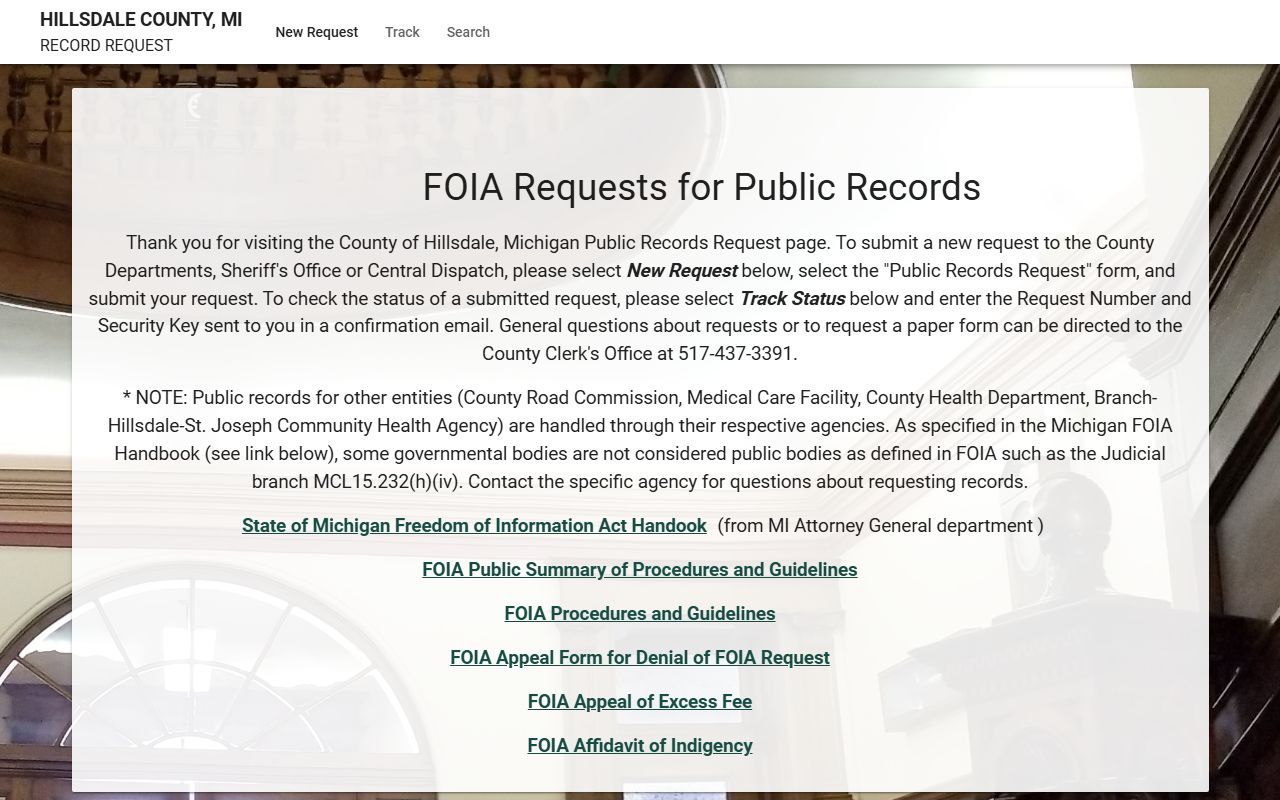
The portal captures your contact details and a description of the record, then routes the request to the office that keeps it. Be specific about the name and any case or incident detail you already have, since a vague request slows the response. Keep in mind that active investigations and certain law-enforcement records can be withheld, so a request does not guarantee a full file.
For questions the portal cannot answer, the sheriff's administrative line is (517) 437-7317, with a toll-free option at (800) 437-7317. A phone call is often the fastest way to learn whether a records request is even the right path for your situation.
Michigan Public Records Law and Warrants
Warrant records live under Michigan's Freedom of Information Act. The law sets who can inspect records, what an office may charge, and which files stay closed. Knowing the three core sections helps you frame a request and understand a denial. Court records also follow separate court rules, so a warrant tied to a case may route through the court rather than a FOIA office.
The foundation is MCL 15.233, which gives the public the right to inspect and copy public records unless a specific exemption applies.
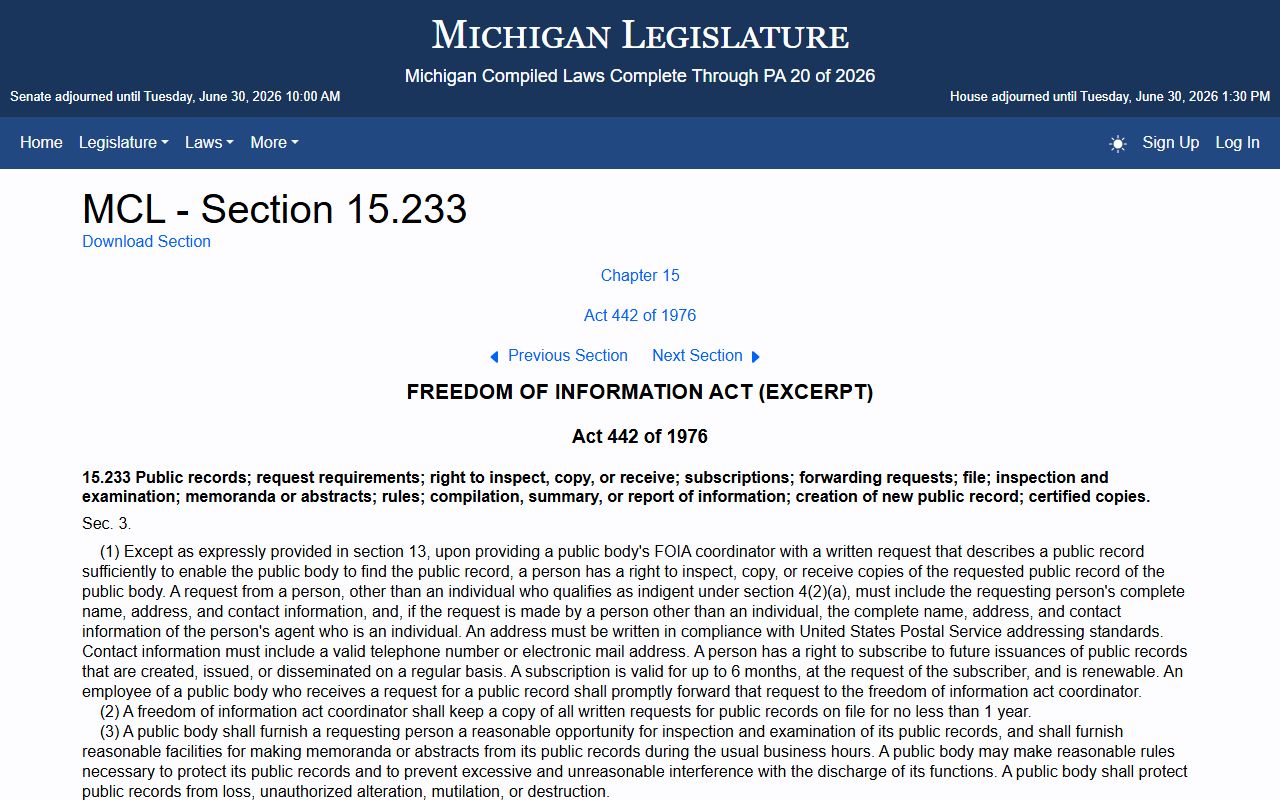
That section is the reason a written request has legal weight even when a county keeps no public warrant list. Fees are handled separately. Under MCL 15.234, a public body may charge for the labor and materials tied to a search and copies, so expect a cost estimate on larger requests.
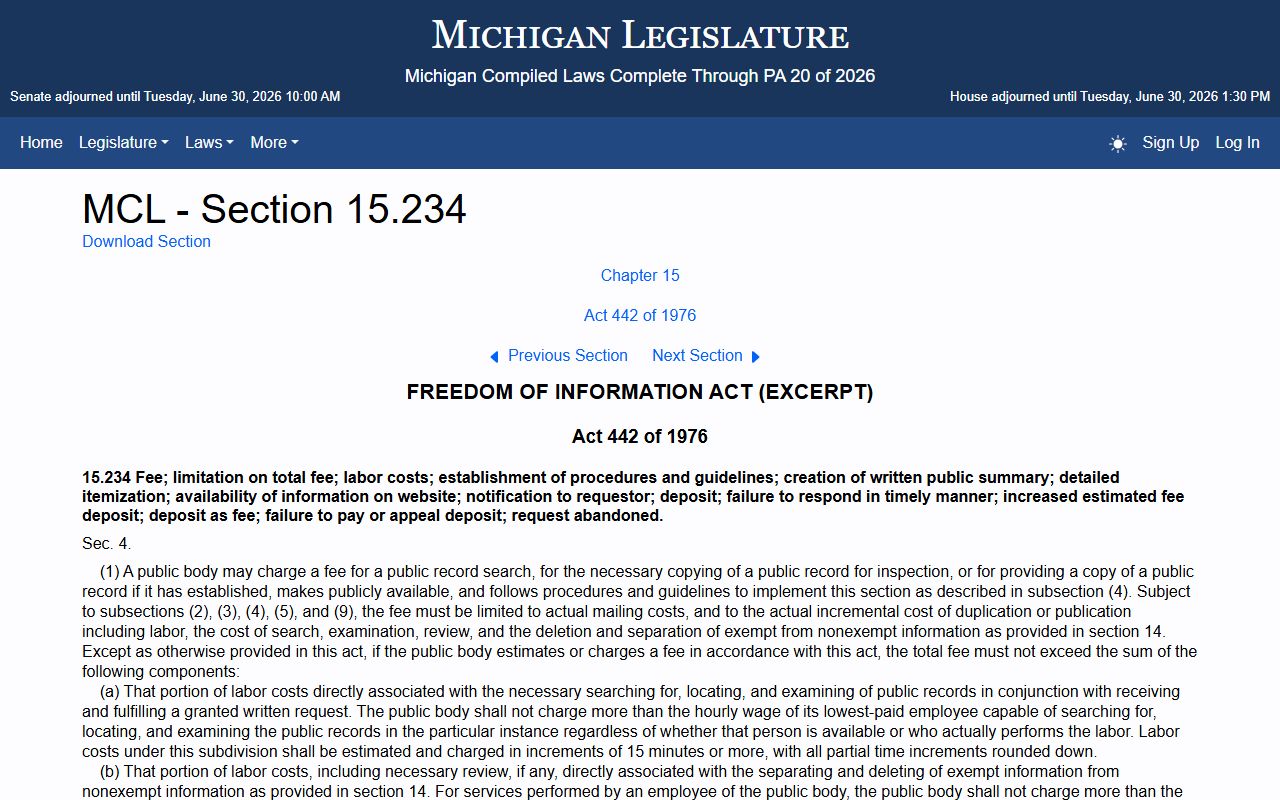
The fee rules explain why the sheriff may ask for a deposit before pulling a large batch of records. Some files never open at all. The exemption list in MCL 15.243 covers active investigations, informant identities, and similar sensitive material, which is often why a warrant tied to an open case stays sealed until an arrest.
Note: A denial under an exemption is not the end of the road, since you can narrow the request or ask the court that signed the warrant once a case becomes public.
What a Hillsdale County Warrant Record Shows
A warrant record is short, but each field carries weight. When the sheriff or the court releases warrant information, or when a case surfaces in the state portal, you can expect the same core fields. Reading them correctly tells you how serious the matter is and where to go next.
| Field | What It Shows |
|---|---|
| Case number | The court file the warrant belongs to, used to track the matter and request the record. |
| Charge | The offense that led to the warrant, from a missed-appearance flag to a felony count. |
| Issuing court | Whether the circuit court or the 2B District Court signed the order. |
| Bond amount | The money or conditions set for release once the person is booked. |
| Status | Whether the warrant is open and active or has been cleared or recalled. |
The case number is the field that unlocks the rest. With it, you can look up the underlying case through the state search system or ask the right court office for the file. The bond amount matters most for planning a surrender, since it sets what release will cost.
Bench Warrants and the District Court
Bench warrants are the most common type tied to everyday county cases. The 2B District Court issues one when a person misses a scheduled hearing, fails to pay a fine, or ignores a court order. The name comes from the judge's bench, since the order starts in the courtroom rather than from a police investigation.
The district court does not offer a public online archive of its records, and it says records must be requested directly from the court. What you can do first is check the statewide case system for the underlying case. The Michigan case search for the 2B District Court lets you look up a person by last name and see open pending matters or a next hearing date.
If a case shows a missed event, contacting the court is the next step. The district court can tell you whether a bench warrant was issued and what it takes to clear it, which often means paying a fine, posting a bond, or setting a new hearing. Acting before an arrest usually gives you more options than waiting to be picked up.
Warrant Tips Through the Sheriff App
The Hillsdale County Sheriff's Office promotes a free mobile app that carries a feature the website does not. Along with road closures and missing-person alerts, the app advertises a channel for crime, warrant, and drug tips. This tip submission is app-only, so it does not appear as a form on any county web page.
The app is a tip line, not a warrant lookup. It lets a resident report information about a wanted person or a crime, and it does not return a search result telling you whether you have a warrant. Anyone hunting for their own warrant status should still use the sheriff phone line or a records request instead.
You can install it from the Hillsdale County Sheriff app on Google Play or the Hillsdale County Sheriff app on the Apple App Store. Both listings describe the same public-safety alert and tip features tied to the local sheriff.
What to Do About a Hillsdale County Warrant
Finding out you have a warrant is unsettling, but a plan beats panic. The worst move is to ignore it, since an open warrant can lead to an arrest at any traffic stop or during any police contact. A steady, informed approach protects your options and often leads to a better outcome in the case.
- Confirm the warrant through the issuing court or the sheriff before you act, so you know the charge and the bond.
- Talk to a lawyer about the case and the safest way to resolve the warrant.
- Arrange a voluntary surrender or a court appearance, which judges tend to view more favorably than an arrest.
- Be ready to post bond or set a new hearing date once the warrant is addressed.
Important: Speak with a defense attorney before you turn yourself in, since a lawyer can arrange the surrender, argue bond, and protect your rights from the first minute.
For a bench warrant over a ticket or a missed misdemeanor date, resolving the underlying case usually clears the warrant. A conviction that follows may later qualify for relief, and Michigan's automatic expungement Clean Slate page explains how some records are set aside over time.
Clearing the warrant is the first job, but understanding the long tail of a conviction helps you plan. The full charge history behind a warrant lives in the Hillsdale County criminal court records, which track the case from arraignment through sentencing.
Custody Alerts After an Arrest
Once a warrant leads to an arrest, the question shifts from "is there a warrant" to "where is the person now." Michigan runs a free notification service for exactly that. VINELink, also branded as MI-VINE, lets anyone register to get alerts when a person's custody status changes, such as a booking or a release.
The sheriff's services page links to the VINELink service alongside its FOIA and public-safety tools. Registration is free and works statewide, so it follows a person even if custody moves between facilities. It does not tell you about a warrant before an arrest, but it fills the gap the moment someone is booked.
To confirm whether a person is already in the county jail, the Hillsdale County inmate records page walks through the public jail roster and the booking details it shows.
Restricted Hillsdale County Warrant Records
Not every warrant is open to the public. Michigan law and court rules close several categories, which is one more reason the county keeps no open roster. Understanding what stays sealed saves you from chasing a record you cannot get.
Juvenile warrants are the clearest example. Records in the juvenile and family division are restricted under Michigan law, and Hillsdale County runs a separate Juvenile Services office to handle them. Sealed and set-aside matters are also nonpublic, so a warrant tied to a case that has been expunged will not surface in a normal search. Federal warrants follow a different system entirely and are handled through the U.S. District Court, not the county sheriff.
Active-investigation warrants round out the list. A warrant tied to an open case can be withheld under the FOIA exemptions until an arrest is made and the case becomes public. When a record is sealed, the right move is to wait for the case to open or ask the court that signed the order rather than filing repeated requests.
Note: A sealed or juvenile warrant will not appear in any public search, so an empty result never proves that no warrant exists.