
What Probate Covers in Hillsdale County
The Hillsdale County Probate and Family Court decides what happens to money, land, and personal property when someone dies. It also protects people who cannot protect themselves. The court opens and oversees estates, admits wills, and appoints the people who settle them. It names guardians for minors and for adults who can no longer make safe choices. It sets up conservatorships to manage funds for a protected person. Adoptions and other family matters run through the same office. Michigan groups all of this work under its probate courts, and Hillsdale County follows that model directly.
One judge leads the court. Judge Michelle A. Bianchi hears Hillsdale County probate matters, and Chief Deputy Register Brennon Balcom helps run the office that keeps the files. The court sits inside the county courthouse in downtown Hillsdale, in the same building as the Circuit Court and the county Clerk of Court.
Probate Terms Defined
Probate filings use words that rarely come up anywhere else. A short glossary helps a first-time reader move through a Hillsdale County estate file without guessing at the language.
- Testator
- A person who makes a will.
- Executor
- The person named in a will to carry out its terms. Michigan calls this role the personal representative.
- Intestate
- Dying without a valid will, which sends the estate down a set order fixed by state law.
- Guardianship
- A court order giving one person the legal authority to care for a minor or an adult who cannot care for themselves.
- Conservatorship
- A court order placing a named person in charge of another person's money and property.
How to Search Hillsdale County Probate Records
Hillsdale County posts its probate hearings on a public court-display docket run by the state court system. That page is date-driven. You pick a day with the RequestDate picker, and the screen shows the judge, the date, and the hearing list for that court. The county also keeps a probate court page and a separate docket page that link out to the same state display. The main statewide case-search portal does not list every probate matter, since Michigan law keeps wills, adoptions, and several protective case types off the public search.
A short walkthrough covers the online path. Older or sealed files still call for direct contact with the court.
- Open the county Probate and Family Court page to find the office contacts and links.
- Go to the public probate court-display docket for the current hearing schedule.
- Use the RequestDate picker to choose a hearing date, then read the judge and event table for that day.
- For a full case file or a sealed matter, contact the Probate and Family Court office in person, by phone, or by mail.
The Hillsdale County Probate Court
The Probate and Family Court works out of Room 3 in the county courthouse. Office hours run Monday through Friday, with a midday closure that many county offices keep. The court also posts an accommodation-request page for anyone who needs ADA help or a language interpreter for a hearing. A look at that page shows how the court expects both walk-in and remote visitors.
The county's own Probate Court accommodation-request page lays out how to ask for hearing access help in Hillsdale County. 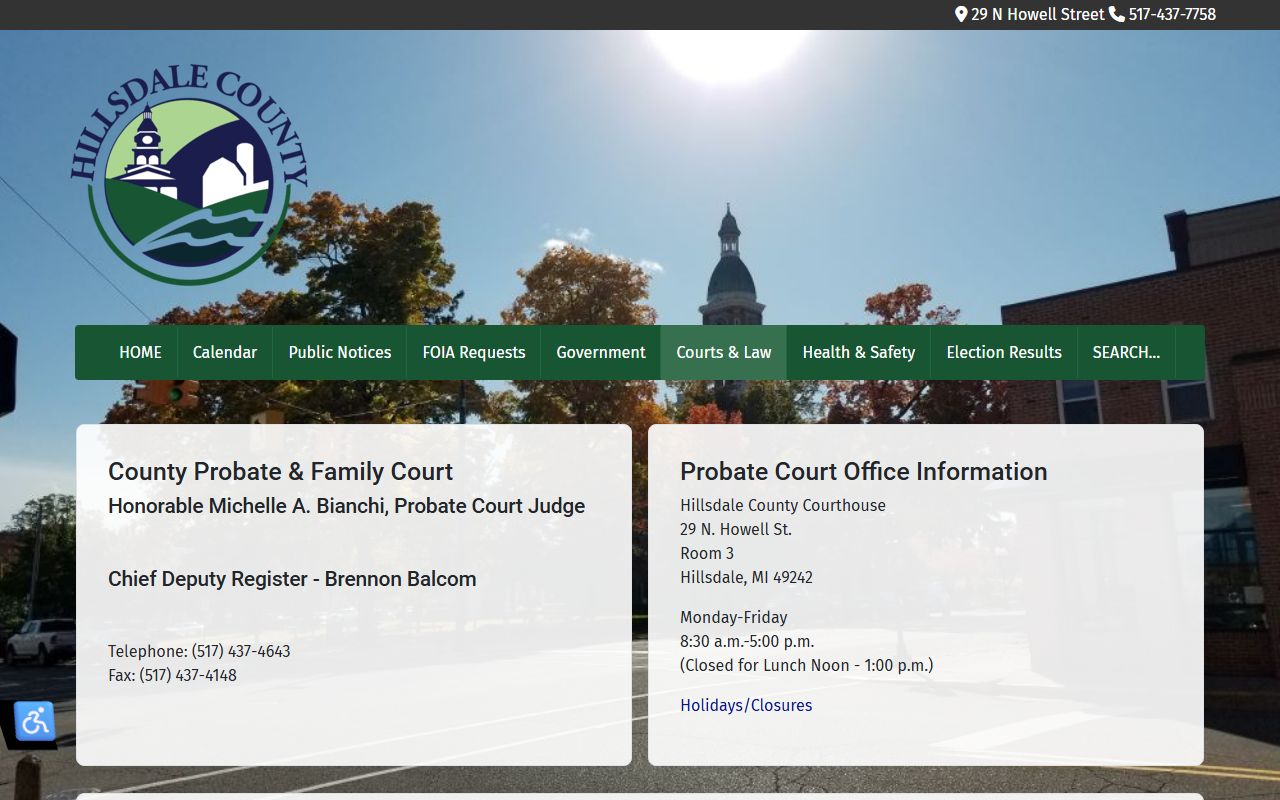 The form-based page confirms that the Probate and Family Court handles both in-person and assisted access, which matters when you plan a courthouse visit to pull a record.
Hillsdale County Probate and Family Court
29 N. Howell St., Room 3
Hillsdale, MI 49242
(517) 437-4643
Mon to Fri, 8:30 a.m. to 5:00 p.m. (closed noon to 1:00 p.m.)
Probate Record Copies and Fees
The county publishes copy fees through the Clerk of Court, and the court charges for copies of documents in a probate file. Filing fees for estates and guardianships are set by Michigan statute rather than by the county, so the amount can change and should be confirmed with the court before you file. The table below lists the copy fees the county documents plus a pointer for statutory filing costs.
| Item | Amount |
|---|---|
| Record copy, per page | $1.00 |
| Case or record search, per name | $10.00 |
| Certified vital copy (first / each additional) | $20.00 / $5.00 |
| Estate and guardianship filing fees | Set by Michigan statute; confirm with the court |
Note: The county does not post a full probate filing-fee grid online, so confirm current estate and guardianship costs with the Probate and Family Court before filing.
What Hillsdale County Probate Records Show
An open probate file traces an estate from start to finish. It can hold the will, the order that admits it, and the letters that name a personal representative. It can hold an inventory of the estate's property, the accountings that show money moving in and out, and the final orders that close the case. Guardianship and conservatorship files show who was appointed, what powers they hold, and the reports they must file.
The public hearing docket shows a thinner slice of the same case. It lists the judge, the request date you chose, and the events set for that day. It does not replace the full file. For the underlying documents, the court office is the source.
Opening an Estate in Hillsdale County
Most probate cases start the same way. After a death, someone files with the Probate and Family Court to open the estate and name a personal representative. If the person left a will, the court reviews it and, when it is valid, admits it and follows its terms. If there was no will, the estate is called intestate, and Michigan law sets the order in which heirs inherit. The court then oversees the representative as they gather assets, pay debts, and distribute what remains.
Guardianship and conservatorship cases follow a parallel track. A petition explains why a minor or an adult needs help, the court holds a hearing, and a judge decides whether to appoint someone and what powers to grant. Each of these matters opens a case file and earns a spot on the public hearing docket, even though the deeper documents may stay with the court. The office in Room 3 is the place to confirm what a specific estate or guardianship filing requires.
Restricted Hillsdale County Probate Records
Not every probate matter is open. Adoptions are part of the Probate and Family Court's work, and adoption files are sealed by law. Minor guardianship records, mental health commitments, and some protective proceedings are limited or closed to the general public. Michigan's statewide case-search portal leaves wills, adoptions, mental illness cases, and juvenile guardianships out of public results, which is why a search can come back empty even when a case exists.
Mental health and protective matters carry their own confidentiality. Michigan court rules and statutes limit who may see mental illness files, and personal protection order matters stay off the public case search. That is why a family member searching online may find nothing, even when a case is active in the courthouse.
To view a limited or sealed Hillsdale County probate record, a person usually needs a legal interest in the case or a court order. The court office can explain who qualifies and what a request must include.
Transcripts and Older Probate Files in Hillsdale County
Hearing transcripts do not come from a general county form. The Probate and Family Court routes transcript requests to Modern Court Reporting and Video, LLC, the vendor that handles circuit and probate transcripts for the county. A written record of a hearing is ordered through that vendor, not pulled from an online archive. The court can tell you which hearing you need transcribed and how to reach the reporting service to place the order.
Very old files can be thin. A courthouse fire in the late 1840s destroyed most of the county's original documents, so the earliest estate records may be missing or reconstructed. For newer matters, a certified copy from the Clerk of Court closes most needs, and a marriage or divorce question is usually better answered through the county's marriage and divorce records office. When a matter reaches the federal courts instead of the county, a free search tool can help.
The nonprofit CourtListener federal court search indexes federal dockets and opinions at no charge.  It does not carry Hillsdale County probate files, but it is a useful backup when an estate dispute crosses into federal territory or when you need related case law.