
Hillsdale County Arrest Records and Court Charges
Arrest records capture the moment a person is taken into custody. The record notes who made the arrest, when it happened, and the booking that follows at the jail. It is a snapshot of the arrest itself, not a ruling on guilt. The booking and custody side of that story, including the current jail roster, lives on the Hillsdale County inmate records page. An arrest by itself does not settle any charge. That job falls to the Hillsdale County Prosecutor, who reviews the arrest and decides what, if anything, to file with the court.
The court charge record is the second half of the picture. Once the prosecutor files, the charges enter the court file and become the charges after arrest that the case will turn on. From that point the charges are tracked through every hearing, and they can change as the case develops. The arrest record and the charge record answer different questions. One shows the stop and booking. The other shows what the state formally accuses. The full case file and its final outcome sit on the Hillsdale County criminal court records page.
How to Find Hillsdale County Arrest Records and Charges
The charges filed after an arrest show up in Michigan's statewide case-search system, MiCOURT. The county runs a district lookup and a circuit lookup, and both feed the same portal. The district court holds misdemeanors and the early steps of most cases, while the circuit court holds felonies. Booking detail from the arrest itself sits in the jail roster, not the case search, so many readers use both tools together.
- Open the MiCOURT case search for the District Court (D02B) or the Circuit Court (C01).
- Search by the defendant's last name, or use the case-number tab when you have the number.
- Open the matching case and read the list of charges filed against the defendant.
- Check each charge for its statute code, its level, and its current status.
Statewide, MiCOURT gathers cases from courts across Michigan, so a name search can surface charges filed in more than one court. Some case types never display, and certain convictions appear only when sentencing fell within the past seven years. When a record does not load, a direct request to the court that holds the case is the reliable backup.
Note:A MiCOURT name search returns court charges, not booking photos, so the jail roster remains the place to confirm a current arrest and custody status.
How Charges Get Filed After an Arrest: Complaint, Information, and Indictment
An arrest starts the clock, but the charge record does not open until a charging document is filed. That document is the formal accusation, and Michigan uses three main forms. A complaint is the entry point for many cases, especially misdemeanors. An information is the felony charging paper the prosecutor files after a probable-cause step. An indictment comes from a grand jury and is reserved for the most serious matters. Each one opens the case and lists the counts the defense must answer.
| Complaint | Information | Indictment | |
|---|---|---|---|
| Filed By | Officer / Prosecutor | Prosecutor | Grand Jury |
| Common For | Misdemeanors | Many felonies | Serious felonies |
| Starts | The case | The case | The case |
In Hillsdale County the great majority of cases open by complaint or information. Grand jury indictments are rare at the county level. Whatever the form, the filing is the moment the charges become part of the public court record.
Hillsdale County Charge Status and What It Means
Charges rarely stay frozen. As a case moves, a charge can be amended, cut to a lesser offense, added, dropped, or dismissed. A felony can be bound over from district court to circuit court once a judge finds probable cause. Reading the status next to each count tells you where that count stands right now. The status can differ from count to count within the same case.
| Status | What It Means |
|---|---|
| Filed | The charge has been entered with the court and the count is active. |
| Amended | The charge was changed, often to correct or restate the count. |
| Reduced | The charge was lowered to a less serious offense. |
| Dismissed | The court ended the charge, and it results in no conviction. |
| Nolle Prosequi | The prosecutor chose not to pursue the charge further. |
| Bound Over | A felony charge was sent up to circuit court after a probable-cause finding. |
Note:A dropped or dismissed charge still appears in the public court file, so the record shows what was filed even when the count never led to a conviction.
Charge vs. Conviction
A charge is an accusation. A conviction is a finding of guilt. The gap between the two is wide, and the court record shows it. A charge rests on probable cause, the low bar that lets a case begin. A conviction requires proof beyond a reasonable doubt, or a plea from the defendant. Many charges never turn into convictions, because they are reduced, dismissed, or dropped along the way. The disposition on each count is what tells you the difference.
| Charge | Conviction | |
|---|---|---|
| Stage | Accusation | Verdict or plea |
| Burden of Proof | Probable cause | Beyond reasonable doubt |
| Public Record | Yes | Yes |
Sealed vs. Expunged Records in Hillsdale County
Not every charge record stays visible forever. Michigan calls the clearing of a conviction a set-aside, the state's term for expungement. A sealed record is hidden from public view but still exists for limited uses. A set-aside record is treated as though the conviction never happened, and it leaves the public case system. Both remove a record from casual searches, though the rules and eligibility differ by charge and by time since sentencing.
| Sealed | Expunged | |
|---|---|---|
| Visibility | Hidden from public | Treated as if it never happened |
| Law Enforcement | Limited access | Very limited access |
| Eligibility | Set by court rule and case type | Set-aside relief under Michigan Clean Slate rules |
Hillsdale County Charge Codes and Severity Levels
Each charge is tied to a Michigan statute, and that code sets the severity. Felonies are the most serious offenses, punishable by more than a year and handled in circuit court. Misdemeanors carry up to a year in the county jail and run through district court. Civil infractions, such as most traffic tickets, bring fines rather than jail. The code on a count tells you which bucket it falls in and which court will hear it.
One arrest can produce several separate charges. A single stop might lead to a felony count, a paired misdemeanor, and a civil infraction, each with its own code and its own path. That is why a case file often lists multiple counts, and why one count can be dropped while another moves ahead. The system also marks attempt-to-commit felony charges with an A in its notes, a small flag that changes how a count is read.
Statewide and Federal Charge Lookups
Because MiCOURT pulls from courts across Michigan, a name search can surface charges filed outside Hillsdale County. That statewide reach helps when a person has cases in more than one court. Access still runs through court rules and the state open-records law, which sets what the public can inspect and what an agency may withhold. Some categories are exempt from disclosure, and those exemptions shape what a search returns.
Federal charges follow a different track. Most Hillsdale County cases stay in state court, but a federal charge would not be filed in the Eastern District of Michigan, which does not cover this county.
The Eastern District of Michigan homepage covers the eastern half of the state, so it is not the venue for a Hillsdale County federal case.
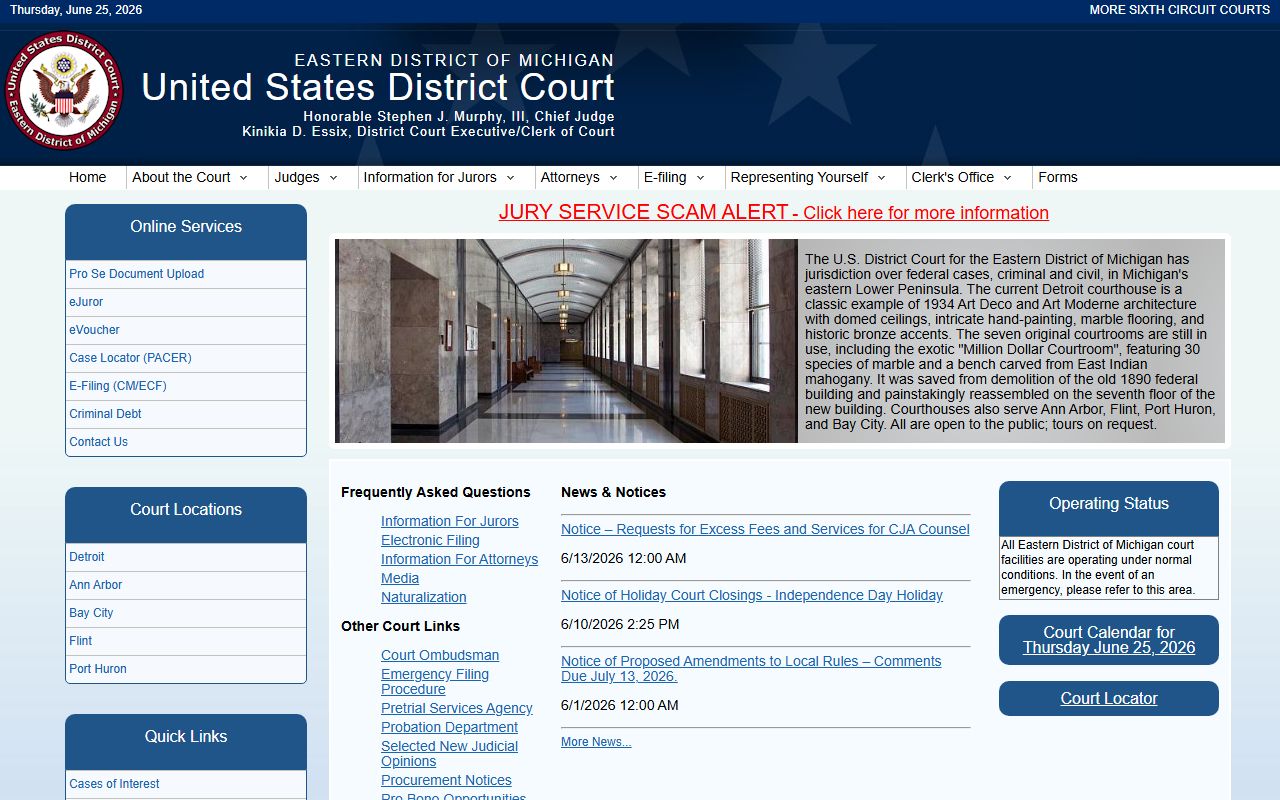
Federal charges arising in Hillsdale County go to the U.S. District Court for the Western District of Michigan, Southern Division at Lansing. The Eastern District page is useful only to show which court does not apply here, so readers do not search the wrong federal system.
Background Check Considerations
Reading a charge record and running a background check are two different acts. A case search shows what a court filed, but it is not a screening report. A regulated background check under federal law must meet strict standards for accuracy, notice, and consent. Employers, landlords, and lenders have to use a compliant service, not a casual court lookup, when a decision is covered by the Fair Credit Reporting Act.
Important: This site is not a consumer reporting agency under the Fair Credit Reporting Act, and its records may not be used to decide credit, jobs, housing, or insurance.
Restricted Charge Records in Hillsdale County
Some charge records stay out of public reach. Juvenile charges are the clearest case, since Michigan keeps family-division juvenile records confidential except as the law allows. Sealed and set-aside convictions also leave the public portal. Dismissed counts can be withheld in some settings, and charges tied to an open investigation may not appear at all. State law lists the specific exemptions that let an agency hold a record back.
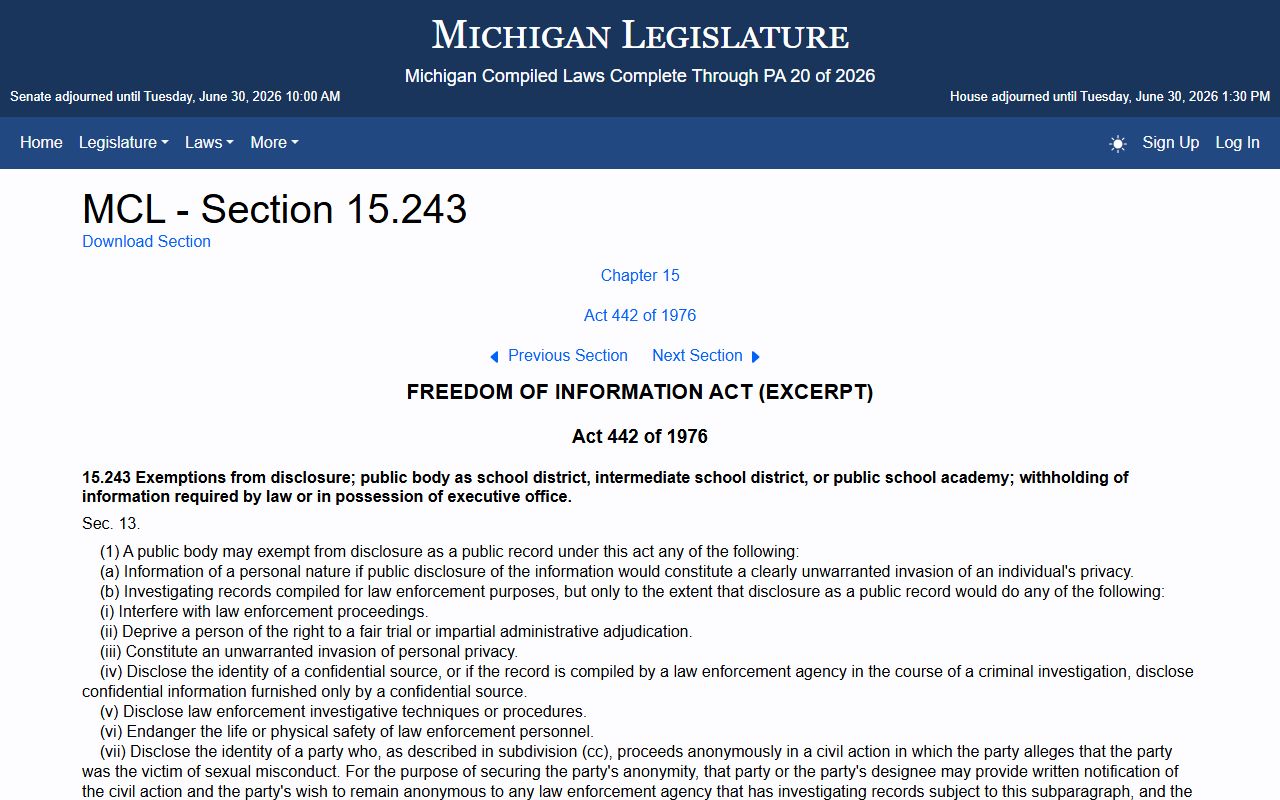
The state open-records law names the categories that are exempt from disclosure, which explains why some charge details never surface in a public request.
Michigan's FOIA exemptions statute, MCL 15.243, sets out the records a public body may withhold from disclosure.
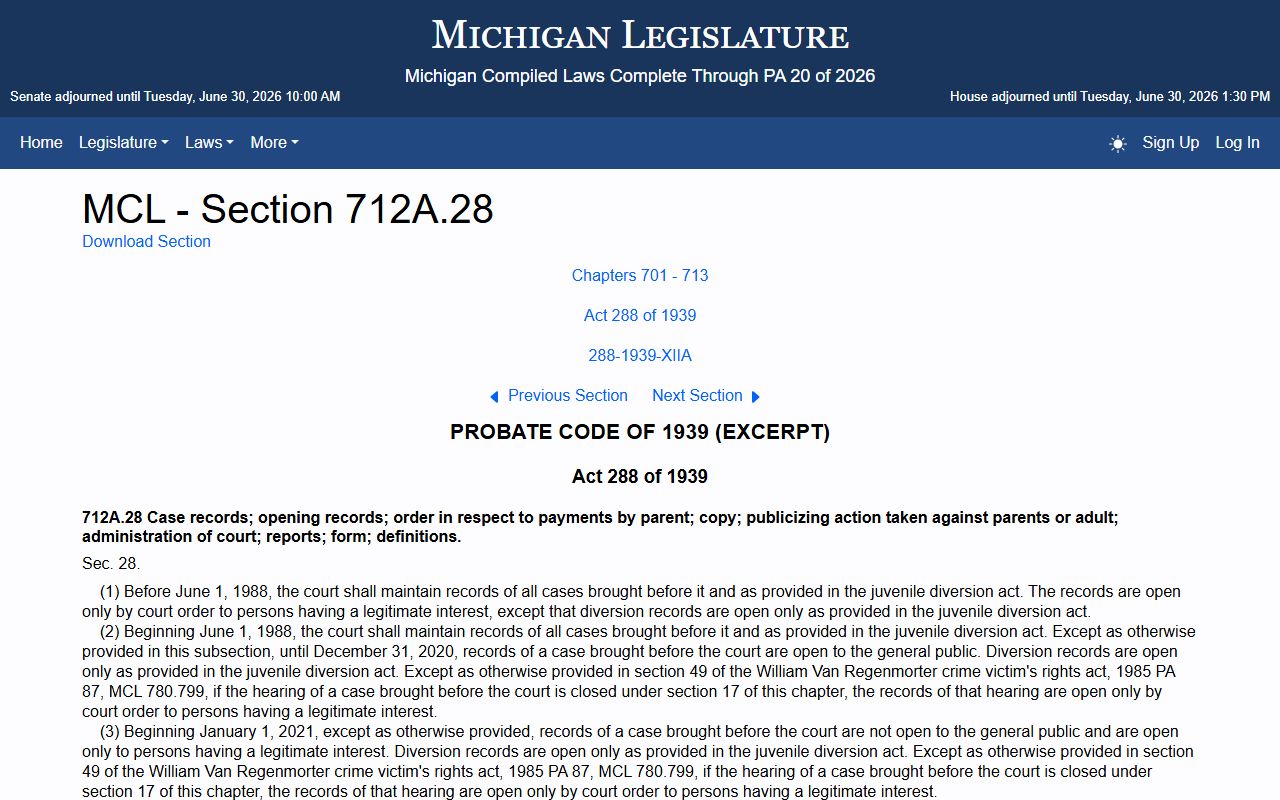
Juvenile matters get their own layer of protection. The law keeps juvenile charge records confidential and limits who may see them, which is why they do not show in a routine name search.
The juvenile record access statute, MCL 712A.28, controls how Hillsdale County juvenile charge records are kept and released.
For questions about a specific charge, the Hillsdale County Prosecutor can be reached at (517) 439-1419, the office that decides what to file after an arrest.
Note:Juvenile charge records are confidential under Michigan law, so they will not appear in a standard public case search of the state portal.