
Criminal Court Records in Hillsdale County
A criminal court record is the case file a court opens the day formal charges arrive. In Hillsdale County the clerk of court keeps that file, and it grows with every hearing, motion, and order. It starts with the charging paper and the name of the accused. It ends with a disposition and, when there is a conviction, a sentence. Between those two points the file logs pleas, bond terms, trial dates, and the judge assigned. The public version is the same record court staff use, minus the parts state law holds back.
Two trial courts handle criminal work here. The 1st Judicial Circuit Court hears felonies, the most serious charges, along with divorces and larger civil suits. The 2B District Court handles misdemeanors, traffic crimes, and the early steps of nearly every felony before it moves up. That split matters when you search, because one arrest can leave a trail in both courts. A felony often opens in district court for the first hearings. It then transfers to circuit court once a judge finds enough cause to send it forward.
How to Search Hillsdale County Criminal Court Records
Most Hillsdale County criminal court records are searched through MiCOURT, Michigan's statewide case-search system. The county runs two lookup pages, one for the Circuit Court and one for the District Court, and both feed the same state portal. You can search by a party's name or by a case number. The result list returns the case, the court, the filing date, and the current status. From there you open a case to read its detail.
- Open the MiCOURT criminal case search for the Circuit Court (C01) or the District Court (D02B).
- Search by the defendant's last name, or switch to the case-number tab if you already have the number.
- Narrow the list with the filters for court, case type, birth year, or a filed-date range.
- Open the matching case to read the docket, the charges, and the disposition.
- Request a certified copy from the clerk of court if you need the record for a legal use.
Not every case appears online. The portal hides adoption, juvenile, mental illness, and several protected categories by rule. Some courts also show a conviction only when sentencing happened within the past seven years. For older files or sealed matters, a direct request to the clerk of court is the dependable route, since the district court says its records must be asked for from the court rather than pulled from a public archive.
Note:Sensitive case types never load in the public portal, so a blank result does not always mean no case exists.
Stages of a Hillsdale County Criminal Case
A criminal case moves through set stages, and each one leaves a mark in the record. The early steps fix the charges and the bond. The middle steps sort out pleas, evidence, and motions. The final steps settle guilt and set the sentence. Reading a file in that order helps you see where a case stands, even when the docket runs long. The charges filed at the start are not always the charges a judge rules on at the end.
Case flow: Charges Filed › Arraignment › Pretrial / Motions › Plea or Trial › Disposition › Sentencing
| Stage | What Happens |
|---|---|
| Arraignment | The accused hears the charges, learns the rights that apply, and the judge sets bond or release terms. |
| Pretrial / Motions | Both sides trade evidence, argue motions, and often talk over a plea. Felonies get a probable-cause step before circuit court. |
| Plea or Trial | The defendant pleads, or a judge or jury weighs the proof and reaches a verdict. |
| Sentencing | After a conviction the judge imposes jail, probation, fines, costs, or a mix, and the record logs the terms. |
What a Hillsdale County Criminal Court Record Shows
A criminal case file is built from labeled fields, and the same fields show up across the MiCOURT results and the case detail. The header data names the case and the court. The party data names the defendant. The event data tracks the charges, the plea, and the outcome. Below is a field-by-field guide to what you can expect to read once a case opens.
| Field | What It Shows |
|---|---|
| Case Number | The unique case ID the clerk assigns, used to pull the full file. |
| Defendant | The name and party type of the person charged, with a year of birth when shown. |
| Charges | Each count as filed, tied to a Michigan statute, with felony or misdemeanor level. |
| Plea | How the defendant answered the charges, such as guilty, not guilty, or no contest. |
| Disposition | How the case ended for each count, from dismissal to conviction. |
| Sentence | The penalty after a conviction, including jail, probation, fines, and costs. |
Two more fields help you read a live case. The case status marks whether the matter is pending, disposed, or closed. The next-hearing field shows the upcoming court date. A balance field can also appear when fines or costs remain owed on the case.
Charges vs. Convictions
Being charged is not the same as being convicted. A charge is an accusation, backed only by probable cause. A conviction is a finding of guilt, proven beyond a reasonable doubt or entered by a plea. A criminal court record can show charges that were dropped, cut down, or ended in an acquittal. Reading the disposition on each count is the only sure way to tell a mere charge from a proven crime.
| Charge | Conviction | |
|---|---|---|
| Stage | Accusation | Verdict or plea |
| Burden of Proof | Probable cause | Beyond reasonable doubt |
| Public Record | Yes | Yes |
A closer look at the charges themselves, including how they get filed and how they change, sits on the Hillsdale County arrest records and charges page.
Reading Hillsdale County Dispositions and Sentences
The disposition is the short answer to how a case ended. Common entries include guilty, not guilty, dismissed, and no contest. A dismissed charge closes with no conviction. A deferred outcome can hold a plea back while the defendant meets set terms, then wipe the count if the terms hold. Each count in a case gets its own disposition, so one file can carry a conviction on one charge and a dismissal on another.
The sentence sits next to the conviction and spells out the penalty. In Hillsdale County a sentence can mix jail time, probation, fines, court costs, and restitution to a victim. The abbreviations in the file stay short. CR marks a criminal case, DOB marks the date of birth, and disposed means the case is complete. When a sentence looks unclear, the clerk of court can confirm what an entry means.
Sealed vs. Expunged and Set-Aside Records
Michigan uses the word set-aside for what many people call expungement. A sealed record is hidden from public view but still exists for limited uses. A set-aside record is treated as though the conviction never happened, and it drops out of the public case system. Both remove a record from casual searches, but they are not the same, and eligibility differs by charge and by time since sentencing.
Michigan has widened who can clear a conviction under its Clean Slate reforms. The state courts explain the program and the eligible charge types on the official overview page.
The Michigan courts Clean Slate page lays out how set-aside relief now works statewide.
That program is why some Hillsdale County convictions leave the public portal on their own. Under the Clean Slate framework, when a conviction is kept only in the court case-management system, the court must set it aside seven years after sentencing. Eligible defendants can also file to clear a record sooner.
| Sealed | Expunged / Set-Aside | |
|---|---|---|
| Visibility | Hidden from public | Treated as if it never happened |
| Law Enforcement | Limited access | Very limited access |
| Eligibility | Set by court rule and case type | Set-aside relief under MCL 780.621 and Clean Slate rules |
The set-aside statute spells out who qualifies and how many convictions can be cleared.
The full text of Michigan's conviction set-aside statute, MCL 780.621, lists the eligibility limits and the filing path.
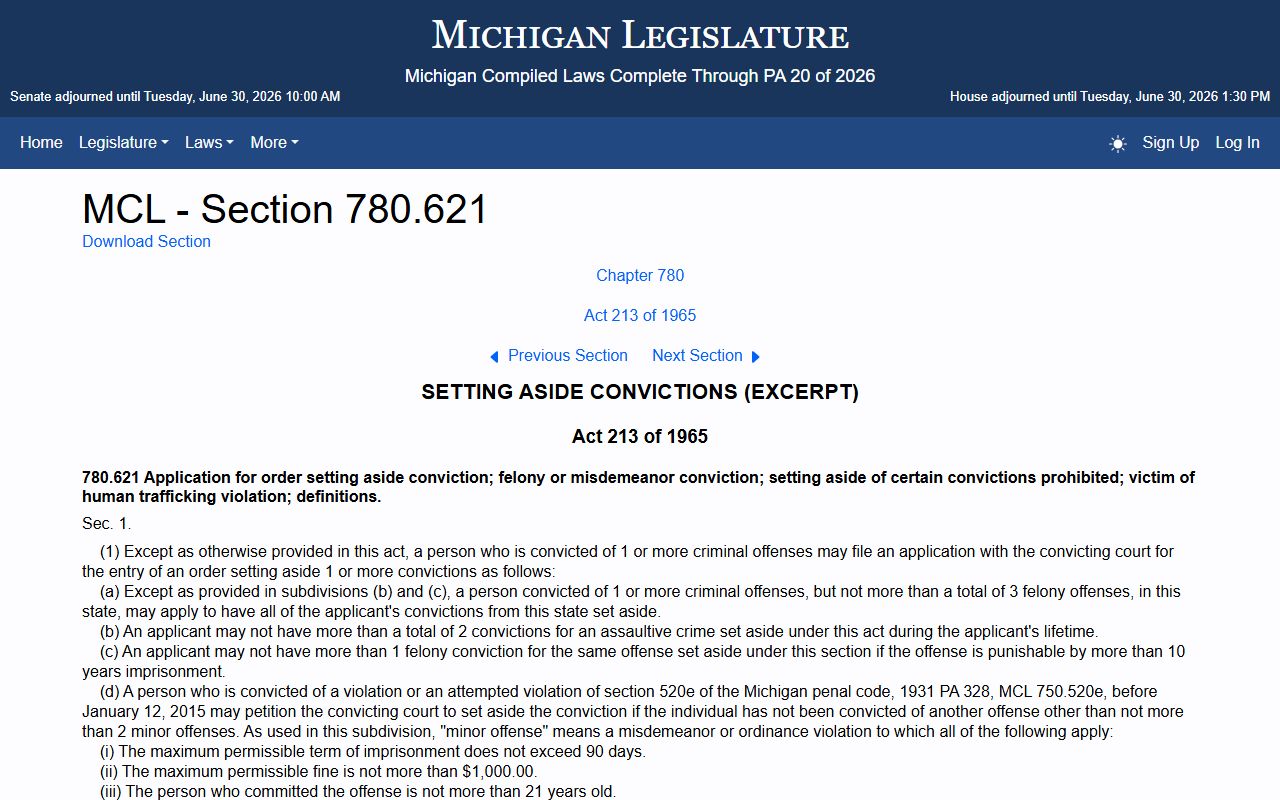
One point catches many people off guard. A set-aside order clears the conviction, but it does not return any fines, costs, or other money already paid on the case. The relief affects the record, not the money.
Note:A set-aside removes the conviction from public view, yet it does not refund fines or court costs that were paid before the order.
Public Access to Hillsdale County Criminal Records
Court files in Michigan are open by default, though courts run under court rules rather than plain public-records law. The Michigan Court Rules set how case records are kept and who can see them. State law also gives the public a right to inspect and copy records held by public bodies, with named exceptions. For court files the surest path is a request to the clerk of court, backed by these two authorities.
Key Statutes:
Michigan Court Rules, MCR 8.119 - governs how Michigan courts keep case records and control public access to them.
Michigan Compiled Laws § 15.233 - gives the public the right to inspect and copy public records unless an exemption applies.
Background Check Considerations
A casual case lookup and a formal background check are not the same tool. Reading a MiCOURT file tells you what a court did, but it is not a screening report. A regulated background check under federal law follows strict rules on accuracy, notice, and consent. Employers, landlords, and lenders must use a compliant service, not a public case search, when a decision falls under the Fair Credit Reporting Act.
Important: This site is not a consumer reporting agency under the Fair Credit Reporting Act, and its records may not be used to decide credit, jobs, housing, or insurance.
Restricted Hillsdale County Criminal Court Records
Some criminal files stay out of public reach no matter how you search. Juvenile cases are the clearest example, since Michigan law keeps family-division juvenile records confidential except as the law allows. Mental illness proceedings and sealed or set-aside convictions also stay off the public portal. Ongoing matters can hold back certain filings until a case reaches a later stage. When a record is restricted, the case may still exist even though it does not show in a name search.
Anyone weighing a set-aside can get help from the state before filing. The Michigan Attorney General runs an assistance program that walks people through eligibility and the forms.
The Michigan Attorney General's expungement assistance program explains how to check eligibility and start a set-aside request.
For the broader picture, every civil, family, and probate file in the county sits alongside these criminal matters in the Hillsdale County court records system, which shares the same MiCOURT search. Local charging questions run through the Hillsdale County Prosecutor at (517) 439-1419, while contracted indigent defense is reached through the county Defense Coordinator at (517) 797-6021.
Note:Juvenile criminal records are confidential under Michigan law, so they will not surface in a routine public name search of the case portal.