
How to Search Hillsdale County Court Records
Most Hillsdale County court files run through Michigan's statewide case-search system. The county posts its own case-lookup pages for the circuit court and the district court, and both of them route into the MiCOURT portal. The county homepage is the front door to those court pages and to the sheriff and clerk offices. You can start a name search or a case-number search from the state site at no cost.
Before you begin, have a full name or a case number ready. A birth year helps narrow common names. The county note on each lookup page warns that some cases will not show online because state law shields the case type. Older files and non-digitized records may need a direct call to the court office.
Here is a lead-in to the county's own site, which links out to every court division. The Hillsdale County government homepage lists the circuit, district, and probate courts along with public-safety offices.
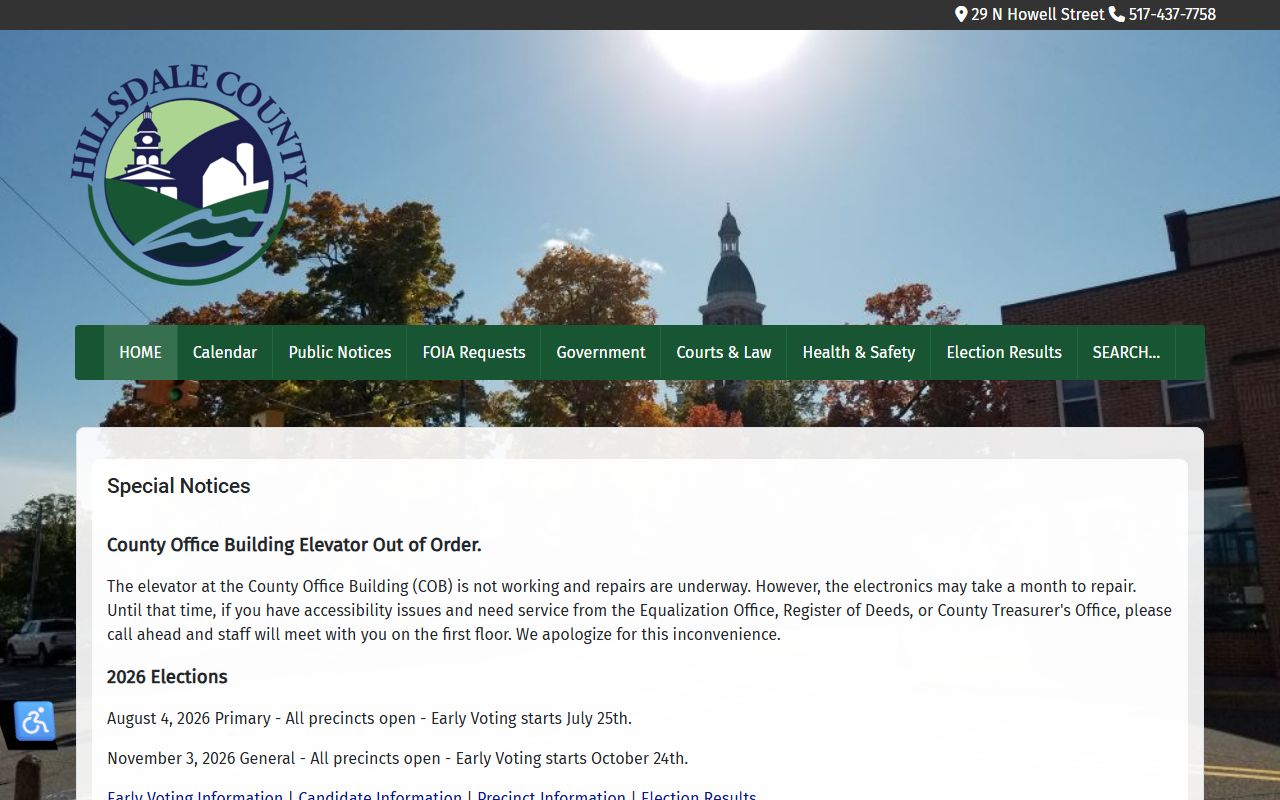
The homepage groups the court, clerk, and sheriff services in one place, which makes it a fast starting point before you jump into a records search.
- Open the MiCOURT case-search portal for the circuit court, or the matching district-court page.
- Pick the Name Search tab and type a last name or business name, then add a first name if you have one.
- Add a birth year and use the case-type filters for civil, criminal, traffic, probate, or juvenile.
- Review the result rows for case ID, filing date, status, and the next hearing date.
- Request a certified copy from the clerk or court office if you need one for legal use.
Note: Some criminal convictions only appear in the portal for seven years after sentencing, so a clean online result does not always mean a person has no record.
The Hillsdale County Judicial System
Michigan runs a four-level court system, and Hillsdale County plugs into it in a plain way. The 1st Judicial Circuit Court is the main trial court. It hears felonies, divorces, and larger civil suits, and it takes appeals from the district court. The 2B District Court handles tickets, small claims, and misdemeanors. The Probate and Family Court covers wills, estates, guardianships, and adoptions.
Above the county, the Michigan Court of Appeals reviews trial-court rulings, and the Michigan Supreme Court sits at the top. Hillsdale falls in the First District for Court of Appeals coverage. The circuit bench is led by Judge Sara Lisznyai, the district bench by Judge Megan R. Stiverson, and the probate bench by Judge Michelle A. Bianchi.
Case flow: District Court › Circuit Court › Court of Appeals › Michigan Supreme Court
| Court | Jurisdiction | Case Types |
|---|---|---|
| Circuit Court | General trial court; appeals from district court | Felonies, divorces, higher-dollar civil, family division |
| District Court | Lower trial court | Misdemeanors, traffic, small claims, lower-dollar civil |
| Probate Court | Estates and protective matters | Wills, estates, guardianships, conservatorships, adoptions |
Federal matters from the county go to the U.S. District Court for the Western District of Michigan, Southern Division at Lansing, which is a separate track from the state courts above. The Michigan courts overview lays out how these levels fit together statewide.
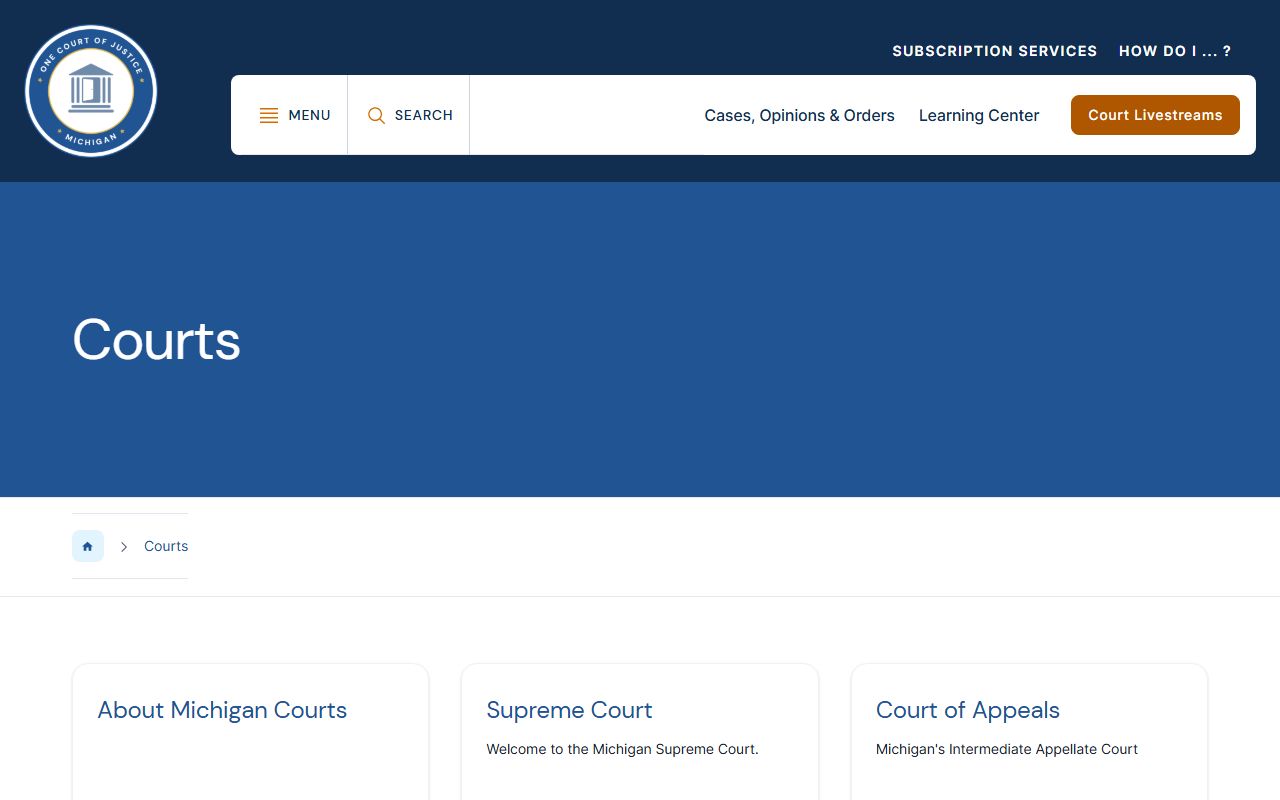
That state page mirrors what Hillsdale County shows locally, with circuit, district, and probate courts each carrying a defined slice of the caseload.
Hillsdale County Courthouses
The county's judicial offices cluster on North Howell Street in downtown Hillsdale. The circuit court and the probate court share the main courthouse at 29 N. Howell St., while the district court works from the courthouse annex a short walk away at 49 N. Howell St. Each office keeps its own room, phone line, and public counter inside the complex.
1st Judicial Circuit Court
29 N. Howell St., Room 6
Hillsdale, MI 49242
(517) 437-4321
Probate / Family Court
29 N. Howell St., Room 3
Hillsdale, MI 49242
(517) 437-4643
All three offices keep regular weekday hours, generally Monday through Friday from 8:30 a.m. to 5:00 p.m., with a midday closure noted for some counters. Note: The district court is an e-filing court and does not offer walk-up public access to its records, so district files must be requested directly from that office.
Types of Court Records Available in Hillsdale County
The county's courts produce a wide mix of records, and the court that hears a case decides where the file lives. Felony and divorce files sit with the circuit court. Tickets, small claims, and misdemeanors sit with the district court. Estates and guardianships sit with the probate court. The clerk holds the vital records tied to marriage and other life events.
Public search surfaces usually show a case number, the parties, a filing date, the status, and any hearing dates. Access is broad for routine cases but narrows for sensitive matters. The district court page is a good example of a division that limits online access and asks the public to request files in person or by mail.
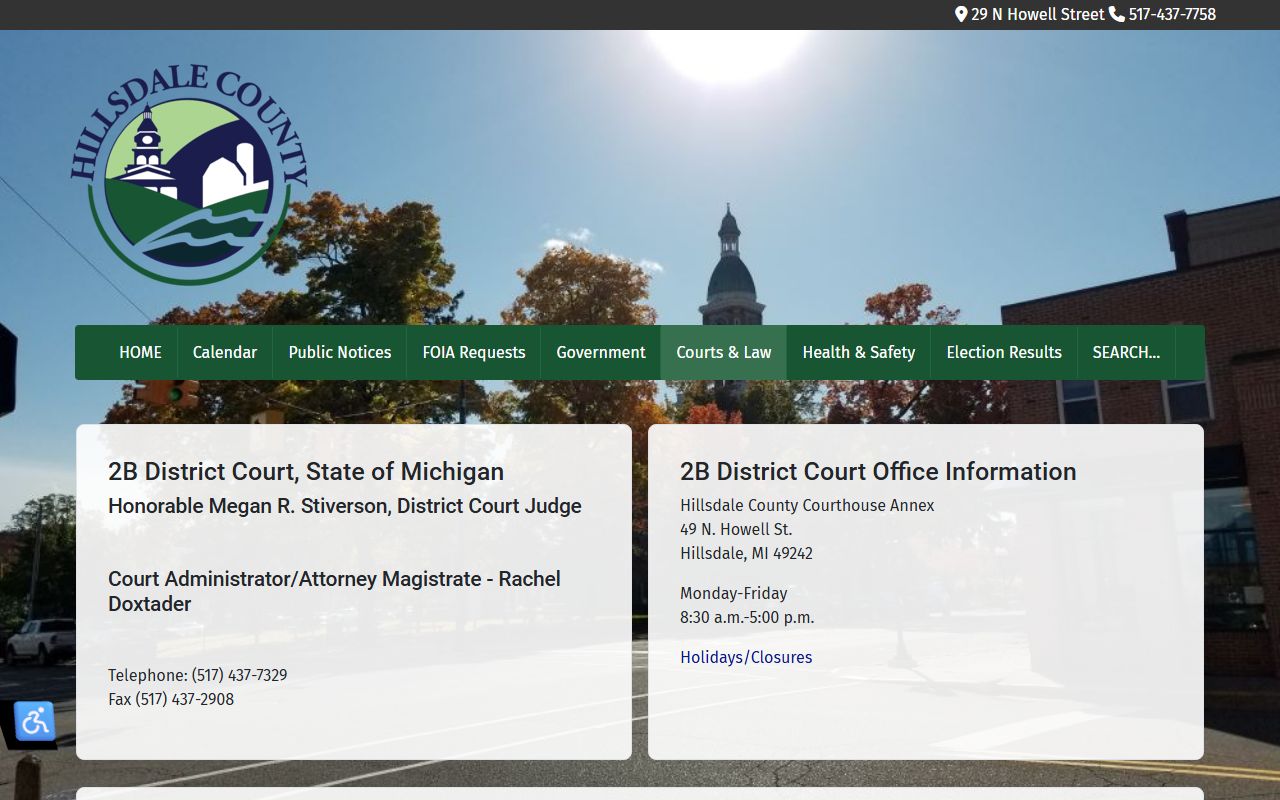
As the 2B District Court page shows, e-filing and pay-fines tools live online even though full case files do not.
- Criminal records - Felonies at the circuit court, misdemeanors and early workflow at the district court.
- Civil records - Larger disputes at the circuit court, small claims and lower-dollar matters at the district court.
- Family and divorce records - Divorces run through the circuit court, not the probate side.
- Probate records - Wills, estates, guardianships, and conservatorships through the probate court.
- Traffic records - Citations handled by the district court and the state ticket portal.
What Hillsdale County Court Records Show
A public case-search result gives you a compact view of a file. The MiCOURT result table lists the case ID, the case title, the filed date, the case status, any balance owed, the court, and the next hearing. It also shows the party name, the party type, and the year of birth. That is enough to confirm you have the right file and to see where the case stands.
The search form itself carries a set of fields worth knowing before you type. Below is the MiCOURT search layout as it appears on the live portal.
| Field Label | Type | Required | Notes |
|---|---|---|---|
| Name Search | Tab | Yes | Default mode for a person or business search |
| Case Number Search | Tab | No | Search by case number |
| Last Name or Business | Text | Yes | Required in Name Search |
| First Name | Text | No | Optional |
| Birth Year | Text | No | Four-digit year |
| Case-type filters | Checkbox | No | Civil, Criminal/Traffic, Probate, Juvenile |
| Filed date range | Date picker | No | Filed From and Filed To |
Docket-display pages add a second layer for hearings. Those pages show the judge name, a request-date picker, and a table of scheduled events, along with a remote-hearing notice when a matter is set for video. Note: The portal will not display certain case types at all, including adoption, mental illness, personal protection orders, name changes, and wills.
Public Access Laws for Hillsdale County Court Records
Two frameworks govern access in Hillsdale County. The Michigan Freedom of Information Act covers most county offices, while court records follow the Michigan Court Rules. County offices are the best first stop for local records, but the courts are not treated as ordinary FOIA bodies, so court files move through court-office requests and the case-management system rather than a plain FOIA letter.
Key Statutes:
Michigan Code § 15.233 - The public may inspect and copy public records unless a specific exemption applies.
Michigan Code § 15.243 - Lists the exemptions that let a public body withhold certain records.
Michigan Court Rule 8.119 - Sets how courts keep, access, and restrict their case records.
Michigan Code § 712A.28 - Keeps juvenile family-division records confidential except as the law allows.
The district court states plainly that its public records can be requested directly from the court, and the sheriff routes booking and jail records through a separate FOIA portal. Marriage applications are a special case because state law keeps the application itself confidential and available only to the people named on it.
Records That Are Restricted or Confidential
Not every court file is open. Juvenile case records are the most protected group, and Michigan law keeps them out of the public case search. The county runs a separate juvenile services office and posts its own accommodation pages, which underscores how the juvenile side is walled off from adult records.
Adoption files, mental-health proceedings, and personal protection matters also stay out of the public portal. Set-aside convictions are treated as nonpublic once a court grants relief. If a conviction lives only in the court case-management system, state Clean Slate rules can set it aside seven years after sentencing. Anyone seeking a restricted file usually has to show a legal reason and ask the court that holds it. A set-aside does not return fines or costs already paid on the case.
Specialty Courts in Hillsdale County
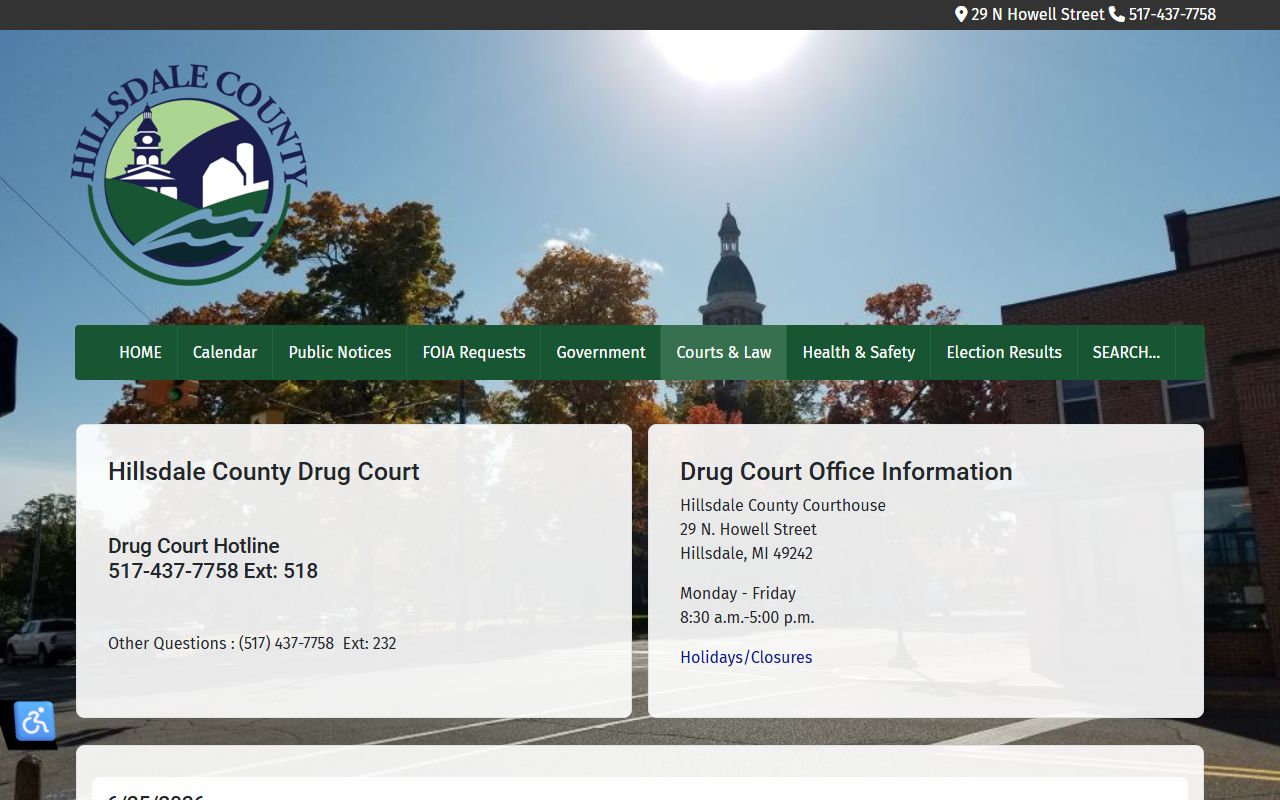
The county runs a focused set of problem-solving programs rather than a broad menu of specialty dockets. Drug court is the flagship. It spans court levels and works with people whose cases tie back to substance use, using check-ins, a hotline, and close supervision instead of a standard sentence alone. The program keeps its own check-in dates and hotline colors for participants.
The Hillsdale County Drug Court page posts the hotline and office details for people in the program.
Alongside drug court, the juvenile services office runs a truancy and juvenile drug-court track. That office helps explain why some youth records never appear in the adult case search. Together the two programs make up the county's real specialty-court footprint, and the county does not publish a separate veterans court or mental-health court page.
Friend of the Court in Hillsdale County
The Friend of the Court office handles the child-support side of family cases. It sits off the main courthouse square and keeps its own staff, records-access form, and 24-hour information line. Parents with support, custody, or parenting-time questions work through this office rather than the circuit court counter. It also runs a SMILE program for families going through divorce.
Friend of the Court
15 Care Drive
Hillsdale, MI 49242
(517) 437-4111
24-hour information line: 877-543-2660
Monday to Friday, 8:30 a.m. to 5:00 p.m.
Records held by this office move through a dedicated records-access request, the FOC 72 form, instead of the general court request path. That keeps support and custody data separate from the open case-search system.
Hillsdale County Sheriff and Jail
The Hillsdale County Sheriff's Office runs the county jail and the public inmate lookup. Sheriff Scott B. Hodshire leads the office from 165 W. Fayette St. The jail uses the JailTracker system for its current-inmate roster, and clicking a name opens booking details and court dates. The facility holds up to 67 inmates in general population plus a set of holding cells for pre-arraignment status.
The county also pushes a Hillsdale County Sheriff app that adds tools the website does not. The sheriff app on Google Play lets residents send tips and get public-safety alerts.
- Public-safety news and road-closure alerts
- Endangered or missing-person alerts
- Crime, warrant, and drug tip submission
For the full roster fields and booking detail, see the Hillsdale County inmate records page, and check the warrant records page for how the county handles active-warrant questions.
Marriage, Divorce, and Probate Records
These three record types split across two offices. The county clerk handles marriage licenses and vital records, while divorces are circuit-court files. Probate matters run through the probate and family court. For a marriage license, you apply as an affidavit with the clerk, and a license is void unless the marriage happens within 33 days. Certified marriage, birth, and death copies come from the clerk or an official online order vendor.
The Probate and Family Court page lists the judge, register, docket link, and transcript vendor.
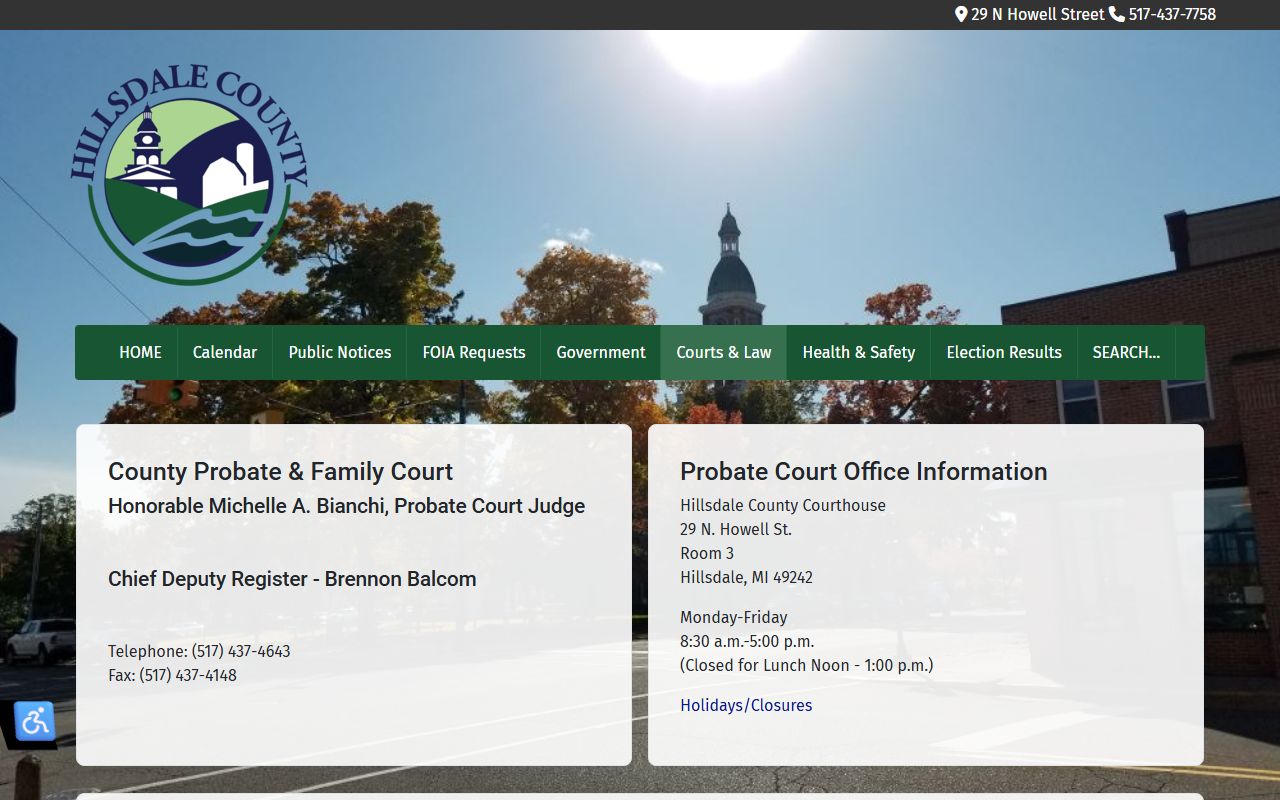
Divorce searches live on the circuit-court side of the case portal, and probate transcripts route through a named outside vendor. For deeper detail, see the marriage and divorce records page and the probate records page. A few probate terms come up often:
- Testator
- The person who makes a will.
- Executor
- The person named to carry out the terms of a will.
- Conservator
- A person the court appoints to manage another person's finances or property.
Hillsdale County Court Records Fees
Copy and search fees are set by the county clerk and posted on the office fee schedule. Certified vital-record copies cost the most, while plain page copies stay low. A criminal or civil name search carries a flat fee. The clerk fee page also notes that online orders for certified vital records do not include shipping or card-processing charges.
| Item | Amount |
|---|---|
| Certified vital copy (first copy) | $20.00 |
| Certified vital copy (each additional, same order) | $5.00 |
| Non-certified birth, death, or marriage copy | $10.00 |
| Criminal or civil case search (per name) | $10.00 |
| All other record copies (per page) | $1.00 |
The full clerk fee schedule also covers business-name lists and voter-file exports. Certified birth records are released only to the person named on the certificate, and a mailed birth request needs a notarized signature.
How to Interpret Hillsdale County Court Records
Court files use short codes that can trip up a first-time reader. Case-type tags mark the division: CV for civil, CR for criminal, PR for probate, JV for juvenile, and DM for a domestic-relations or divorce matter. A status of pending means the case is still active, disposed means the case is complete, and closed means the record is no longer active.
Two ideas cause the most confusion. A charge is only an accusation, while a conviction is a finding of guilt, so a filed charge does not prove a person did anything. The disposition line is where you learn how a case actually ended. In the state system, an attempt-to-commit felony charge is flagged with the letter A in the case note, which is a small detail that changes how a charge reads.
Accuracy and Record Limitations
Online records lag behind the paper file. A new filing, a plea, or a corrected entry can take time to reach the public portal, and some divisions never post full files online at all. The county's district court is the clearest example, since it asks the public to request records directly rather than browse them.
Note: Confirm any name, date, or case detail with the court or clerk office that holds the file before you rely on an online result for a legal or financial decision.
History of Hillsdale County Courts
Court records in Hillsdale County carry a gap that traces back to a fire. The county's first courthouse on the current square was built in 1843, and it burned in 1847 or 1848, which destroyed most of the county's original documents. A second courthouse, known as the old stonepile, went up in 1850 and 1851, and the current courthouse dates to 1898.
The county seat also moved. Jonesville served first before the seat shifted to Hillsdale in 1843. That early loss and the seat change matter for research, because the oldest files can be sparse or missing, and some early material may be indexed under Jonesville or early Hillsdale references rather than a modern case number.
Frequently Asked Questions
How do I search Hillsdale County court cases online?
Use the MiCOURT case-search portal, which the county links from its circuit and district court pages. Pick the Name Search or Case Number Search tab, enter what you have, and use the case-type filters to narrow the results. The search is free, though some case types will not display because state law shields them.
Why can't I find a case I know exists?
Several case types never appear in the public portal, including adoption, mental illness, personal protection orders, name changes, and wills. Juvenile records are also restricted. Some criminal convictions only show for seven years after sentencing. Older or non-digitized files may exist only in paper form and require a direct request to the court office.
Are Hillsdale County district court records online?
The district court is an e-filing court, but it does not offer full public access to case files online. You can look up basic case information through MiCOURT and pay fines online, yet complete records must be requested directly from the court at 49 N. Howell St. or by phone at (517) 437-7329.
How much does a certified copy cost?
The county clerk charges $20.00 for the first certified vital-record copy and $5.00 for each additional copy in the same order. Non-certified copies of birth, death, or marriage records are $10.00. Most other record copies are $1.00 per page, and a criminal or civil name search is $10.00 per name.
Where do I find divorce and marriage records?
Marriage licenses and certified marriage copies come from the county clerk in Room 1 of the courthouse. Divorce cases are different, because they are circuit-court files searched through MiCOURT. The marriage application itself is confidential under state law and is available only to the people named on it.
How do I check on someone in the county jail?
The sheriff's office posts a current-inmate roster through JailTracker, where clicking a name opens booking and court-date details. The Hillsdale County Sheriff app adds public-safety alerts and a tip channel. For the full roster fields and visitation details, see the inmate records page on this site.